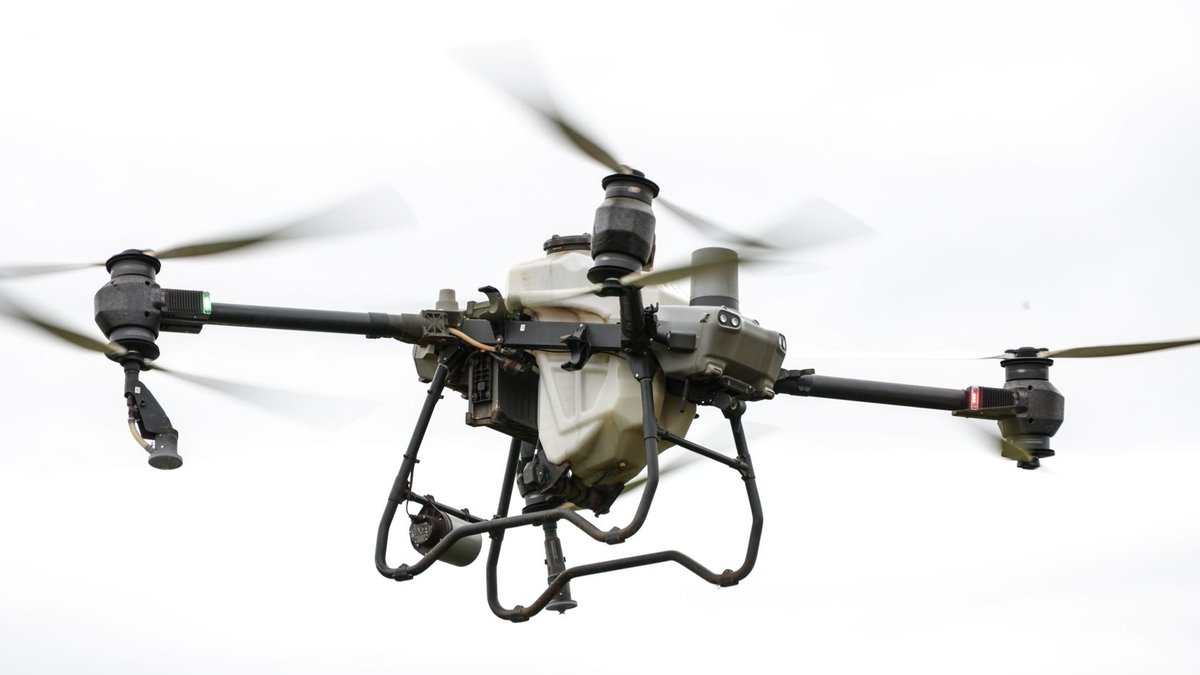
Canada’s drone technology ecosystem is taking shape as companies scramble to meet new defence-industry mandates and secure federal funding for home-grown unmanned systems.
Volatus expands its footprint
At Mirabel Airport outside Montreal, a single worker is tinkering away under high overhead lights on a cavernous factory floor in a 50,000-square-foot plant that Volatus Aerospace Inc. recently leased. The space, once a catering operation, now houses hardware for Chinese-made drones and Elon Musk’s Starlink internet service, with the red-and-white hues of a Tim Hortons box standing out as a visual reminder that Volatus is a Canadian company trying to pivot into domestic defence work.
“That’s what this facility is all about,” said Glen Lynch, chief executive of Volatus, from a conference room overlooking the factory floor. “This was in response to the government’s change in policy in the Defence Industrial Strategy.”
The company has built a market value of $315 million by running millions of kilometres of drone surveillance and inspection flights on utility lines and pipelines that span North America, including its rugged, remote corners.
It plans to automate the Mirabel site with guidance from the Business Development Bank of Canada. Lynch predicted there would be more than 100 people in the facility by 2028 as well as robots.
Policy shifts drive demand
In February, the government unveiled a Defence Industrial Strategy (DIS) that makes “Buy Canadian” a core guiding principle. The policy proposes picking and designating domestic firms to become anchor customers within specific areas.
The latest federal budget earmarks $2.3 billion over five years to move promising Canadian drone technology from concept to testing to production, hoping a few firms will grow into national champions.
Because drones require less capital than submarines or fighter jets, the barrier to entry is low. Unlike submarines or fighter jets, manufacturing drones doesn’t require billions of dollars in upfront investments to build specialized infrastructure, such as dry docks. Instead, anyone with a 3D printer can theoretically get in the game, prompting Ottawa to seek sovereign capacity for building, repairing and upgrading these platforms without depending on foreign countries.
“Our Armed Forces currently have but 2,000 drones in our inventory,” Carney said in September while meeting Ukrainian President Volodymyr Zelenskyy in Calgary. “In the years to come, we will need millions.”
To speed procurement, the Defence Drone Initiative was launched in July, creating a pre-qualified list of suppliers that can be called upon without starting each contract from scratch. Hundreds of companies are already on the list now and new companies can join every quarter.
Volatus won a contract in September to supply as many as 5,000 low-cost, tactical-intelligence drones to the Canadian military for $25 million, provided it can supply 100 drones that satisfy expectations first.
Although it posted $34 million in revenue in 2025, the firm still describes itself as a “platform” rather than a traditional manufacturer. It has gained experience, proprietary technology and large amounts of data by flying various aircraft, from piloted planes to unmanned autonomous drones, both large and small.
Instead of producing the initial batch in-house, it is outsourcing the job to a United Kingdom-based company. If successful, Volatus will invest in manufacturing in Mirabel, a model Lynch said keeps the company nimble in a quickly evolving technology sector.
Analysts at Stifel Canada estimate that installing injection-mould-making equipment at the plant could cost about $750,000 or less, enabling output of hundreds of units each month. They also said drone manufacturing is still largely done by hand at many Canadian companies, many of which, including even companies winning military contracts, are still in a startup stage with limited resources.
Supply-chain development remains a challenge, especially for maintaining capacity during peacetime and adapting to rapid technology shifts.
“It is not only the drone technology” that’s rapidly evolving, said Kevin Thériault, business development manager of defence and security at Montreal-based CAE Inc., a manufacturer of aerospace simulation and modelling technologies. “It’s all the associated technologies, such as communication, data
Industry response to Ottawa’s multi-billion drone initiative
“Products are temporary,” Volatus CEO Glen Lynch said. “That’s the first word you have to remember. Hardware, software are temporary. The technology evolves every 30 days.” The company outsources most drone production, a strategy that keeps it from being tied to any single technology. Volatus notes that as hardware becomes commoditized, Canada aims to become a trusted drone-software provider for NATO allies. Stifel analysts say winning a contract to monitor Canada’s Arctic coastline would generate recurring revenue because of the region’s extreme conditions.