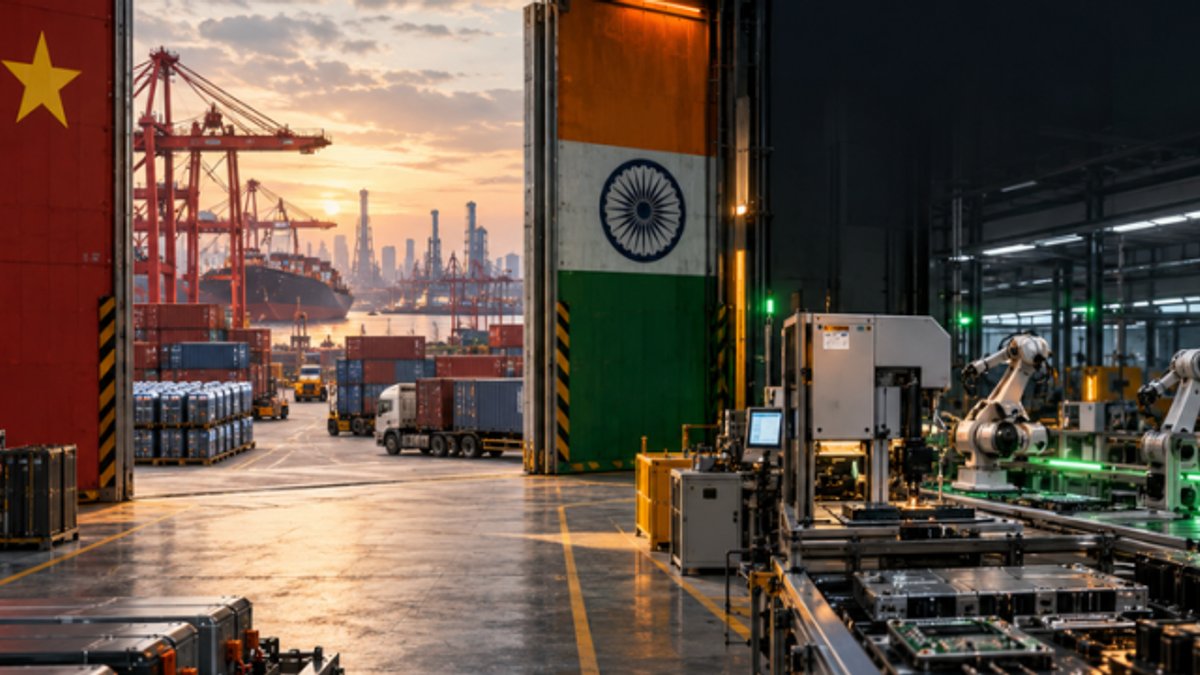
After years of tension, India is cautiously reopening its economic relationship with China. The 2020 border dispute led to tightened scrutiny of Chinese investment and technology, but India’s recent easing of investment rules suggests a shift towards pragmatism.
Despite political distance, China remains deeply embedded in Indian supply chains. India’s trade deficit with China exceeded $112 billion in 2025-26, and Indian manufacturers rely on Chinese components, machinery, and technology. The challenge is to engage China selectively without deepening dependence.
The China Dependence India Never Really Lost
Chinese products and technologies continue to enter India, despite restrictions on Chinese companies. China’s competitiveness in electronics, machinery, batteries, and other industrial goods makes it an attractive supplier for Indian companies operating in a price-sensitive market.
India faces a dilemma in its manufacturing ambitions. Many imports from China are components or intermediate products used in Indian manufacturing. The goal is to build domestic capability, reducing the need for these imports over time.
Make In India Meets Made In China
India’s industrial strategy faces a contradiction. The Make in India initiative aims to deepen domestic supply chains, but China has already established manufacturing ecosystems in key sectors like electronics, batteries, and electric vehicles.
In 2026, India approved a limited easing of investment rules for neighboring countries, including faster decisions for manufacturing proposals. This pragmatic approach allows for selective use of Chinese capital, technology, and expertise to accelerate Indian production.
The focus is on bringing capabilities into India, not just products. Indian factories must strengthen domestic capabilities with every partnership, rather than remaining dependent on Chinese components and technology.
Electronics and electric vehicles are key sectors for this strategy. While India has made progress in mobile phone manufacturing, many components still come from China. EVs present an even greater challenge due to China’s dominance in batteries, motors, and manufacturing.
Chinese collaboration can provide Indian companies with access to technology and supply chains, but it must not compromise Indian decision-making or self-reliance. Younger Indians are also shifting their preferences, valuing design, technology, and brand image alongside price.
Chinese companies cannot rely solely on low prices, while Indian companies must offer quality products, not just patriotism. The battle will be about delivering the best combination of price, technology, and aspiration.
National security remains a priority, with critical technologies and infrastructure receiving scrutiny. India must balance engagement with China against the need for self-reliance. Selective engagement, competing where possible and collaborating to accelerate domestic capability, is the likely strategy.
Ironically, India may need to work with China to reduce dependence on Chinese products. Chinese capital and expertise could help build Indian factories, suppliers, and technology. However, if the relationship results in more Chinese control over critical parts of the value chain, India will have simply replaced one form of dependence with another.
The Factory Is The New Battleground
Electronics and electric vehicles (EVs) will be the most significant testing grounds for India’s strategy. The EV sector is even more challenging, with China dominating batteries, motors, electronics, components, and manufacturing processes. India aims to develop this ecosystem domestically, but China’s scale is a major hurdle.
The Consumer Is Changing Too
India’s young consumer base is evolving, which could alter the China-India relationship. While affordability remains key, younger consumers value design, technology, brand image, and identity alongside price. They have grown up with global brands and digital platforms, influencing their purchasing decisions.
National security will remain a primary constraint on India’s engagement with China. Critical technologies, telecommunications, sensitive infrastructure, and strategic supply chains will face heightened scrutiny. India cannot treat every Chinese investment as a standard commercial transaction.